Monday, September 15, 2014
Tuesday 16 September walk by Champagne Valley walking club.
This Tuesday 16 September we will be walking in the uKhahlamba world heritage site. The walk to Sterkspruit falls and on to Nandi's falls is a moderate walk of about 3 hours. Phone Carol Knowles for details 036 4681010.

Sunday, September 7, 2014
Hikes in the Central Drakensberg 9 September
The Champagne Valley walking club will be visiting the Black Ox shelter on 9 September. This delightful cave, although close to the beaten track is secluded and unless one knows the whereabouts is hard to find. It contains a few Bushman paintings one of an Ox with a black head, possibly a touch up of the original. The cave although threatened by alien wattle encroachment is in a beautiful setting with a waterfall flowing over the top and a rock pool below. The walk starts at Champagne Castle hotel at 8.00 am and is a moderate walk of about 3 hours. Please note that painted caves may only be visited by an AMAFA approved guide. All welcome
Phone Carol Knowles on 082 4946062 for details.
Phone Carol Knowles on 082 4946062 for details.
Saturday, August 30, 2014
Tuesday 2 September walk in the Central Drakensberg.
This Tuesday the Champagne valley walking club will be visiting Barry's grave and the Blue Grotto. John Barry a pioneer mountaineer died in a tragic climbing accident in the early part of the last century and he was buried in a spot with full view of his beloved mountains. Our walk goes to the grave and starting point of the Drakensberg canopy tour and back along the Nkwakwa river via the Blue Grotto to Drakensberg sun hotel. We meet at the Drakensberg Sun Car Park at 8.00 am. Visitors welcome.Phone Carol Knowles for further details. 036 4681010 or 082 4946062
Sunday, August 17, 2014
Central Drakensberg walking club August walking schedule
The Champagne Valley walking club is a group of local hikers who do a walk in the Champagne Valley area each Tuesday. Hikes range from easy 3 hour walks to longer 7 hour hikes and visit various places of interest in the area.Visitors are welcome and will enjoy meeting the locals and the conversation ranging from "No till agriculture" to 'alien" visits with a bit of useful banter in between. Phone Carol Knowles on 036 4681010 or 0824946062
August program.
19 August- Meet at Cedarwood Village at 8.00 am. We will take cars to Cayley Lodge and walk to the painted cave above the Ama Swazi settlement and view the paintings with an AMAFA approved guide and then have morning tea on the rock ledge above.
26 August.- Meet at Champagne Castle hotel at 8.00 am. We will walk past the Henderson's house and on to the top of Cathkin Estates to visit a small cave for tea and then back again.
August program.
19 August- Meet at Cedarwood Village at 8.00 am. We will take cars to Cayley Lodge and walk to the painted cave above the Ama Swazi settlement and view the paintings with an AMAFA approved guide and then have morning tea on the rock ledge above.
26 August.- Meet at Champagne Castle hotel at 8.00 am. We will walk past the Henderson's house and on to the top of Cathkin Estates to visit a small cave for tea and then back again.
Sunday, August 10, 2014
Central Drakensberg walking club- Tuesday walk
This Tuesday 12 August we will meet at Thokosisa at 8.00 am and take cars to Drakensville for a walk to the plateau above for tea . A moderate 3 hour walk.
Wednesday, January 15, 2014
White Butterflies
The White Butterfly Migration


Family: Pieridae
Average Size: 5cm wingspan
Identification: Wings are white or yellow, with irregular black or brown borders.
Distribution: The brown-veined White (Belenois aurota) and Meadow White (Pontia helice) are widespread. The remaining 13 species occurring in the region are restricted to the eastern or north-eastern parts of Southern Africa.
Behaviour: The Brown-veined White sets out on mass summer migrations in a north-easterly direction in southern Africa. Males of most species have a fast flight. Females fly more slowly looking for food plants on which to lay eggs.
Early stages: Eggs are yellow or red and are laid singly. The caterpillars are variable in colour, most are green, often with yellow stripes; they have stiff hairs along the sides of the body and around the head. The caterpillar moults in five separate growth stages over a period of four weeks. The chrysalis is either brown or green, with a blunt spine at the top and on each side of the chrysalis; attached by the tail end in an upright position. Adults emerge after two weeks
Food: Commonly plants in the caper family.
Notes: Spines on the chrysalis mimic spines on the host plant, which provides camouflage.


Family: Pieridae
Average Size: 5cm wingspan
Identification: Wings are white or yellow, with irregular black or brown borders.
Distribution: The brown-veined White (Belenois aurota) and Meadow White (Pontia helice) are widespread. The remaining 13 species occurring in the region are restricted to the eastern or north-eastern parts of Southern Africa.
Behaviour: The Brown-veined White sets out on mass summer migrations in a north-easterly direction in southern Africa. Males of most species have a fast flight. Females fly more slowly looking for food plants on which to lay eggs.
Early stages: Eggs are yellow or red and are laid singly. The caterpillars are variable in colour, most are green, often with yellow stripes; they have stiff hairs along the sides of the body and around the head. The caterpillar moults in five separate growth stages over a period of four weeks. The chrysalis is either brown or green, with a blunt spine at the top and on each side of the chrysalis; attached by the tail end in an upright position. Adults emerge after two weeks
Food: Commonly plants in the caper family.
Notes: Spines on the chrysalis mimic spines on the host plant, which provides camouflage.
Friday, June 21, 2013
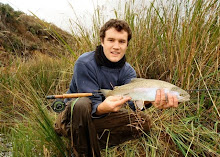
Drakensberg fly fishing catches
The latest catches at Wits End Dam were 2 Natal Yellowfish caught on 12/01/2014 by Gary Frances from Ballito on a Kanberg Nymph # 12. The dam was first
stocked with a small number of adult breeding
fish in 2006 under the supervision of the KZN conservation services
and are thriving in the dam. In the summer months the breeding size fish migrate upstream to spawn on the gravel beds in the approaches to the dam.

Subscribe to:
Posts (Atom)